105 Ways to Give a Book
Showing posts with label School. Show all posts

Thursday Three: Reading Help

With my kids going back to school this week, I updated this post I did at PBS Booklights about helping your child with reading during the year. It's broken it down to the three people involved in your child's reading development - the teacher, the child, and yourself. Here are ways to help each.

1. Helping the Teacher
With class sizes growing and budgets shrinking, teachers need the help of parents more than ever. While you can't present the state-regulated curriculum, any parent can help with building reading skills. If you're good at reading aloud, offer to come in and read to the kids once in a while. Better yet, ask about that state-regulated curriculum and find books at your library that can support it. When my children were studying Native Americans, I brought in folktales to read. How Chipmunk Got His Stripes is one of my favorites. When they learned about insects, I brought in Farfallina and Marcel. You can also use the storytime to bring more depth to issues the teachers don't have time to cover in class. During the 2008 election, I was happy to share Grace for President.

There may be other ways you can help if you're not comfortable being a storytime presenter. Our school had a pull-out program for children who needed a little extra help with reading. Volunteer parents would bring the kids out in the hall for fifteen minutes, select beginning reader books, read along with them, and send the books home for them to practice in the week. This take-home reading program worked very well in giving kids a little extra attention and needed very little training. Volunteer parents also came in on occasion to help the children write stories, to run small book groups, and to prepare materials.

2. Helping Your Child
Other than potty training, I've found nothing that has tested my patience on a continual basis more than the beginning reading stage. There are wonderful successes, often followed by the third laborious rendering of the word then. It can be very frustrating for both of you. So you can help your child by remembering that she will benefit most in her reading growth by mixing up the type of reading she does. Books that are easy for her will reinforce the feeling that reading can be just pure fun. Books that are in her comfort zone will give her confidence of her skills. Books that are a challenge will push her learning to the next level. In fact, while this approach seems somewhat natural for the early reading stage, it applies throughout a person's reading life even to adulthood. It is one of many reasons that kids (and grown-ups) are never too old for picture books. Please don't be one of those parents I see in the library telling their first graders that they can't bring home a "baby book." A better approach is to let that first grader bring home some books that he chooses, and some more challenging books that you choose.

3. Helping Yourself
My last sentence leads nicely to one of the main ways that you can help yourself, and that is to avoid The Reading Game. You know it. It starts with something like, "We can't tear Jacob away from Harry Potter. What is your child reading?" This parental competition starts early ("Lizzie was smiling at us at two weeks) and goes on ("Jamal made All-Stars again!") and on ("Well, Reggie is going to Harvard, but I'm sure that's a good school too."). You'll find the competition in many factors of a child's growth, but verbal skills and reading level seem to dominate. In all my years as a parent, no one has ever asked me if my kids can do long division or sing in tune or climb a tree. But from the first year, I've been asked to compare what words they were saying and then what words they recognized and then what words they were reading until it was all about reading and levels and books.

There is only one way to win this game, and that is not to play. Don't let yourself get sucked into the competition, don't let yourself feel bad, and don't let yourself push your kid based on these conversations. Also, don't let yourself get too proud either, because kids have a way of surprising you. My oldest daughter had a slow start to reading, made methodical progress in first grade, and suddenly made a huge leap in reading level. Now she's looking at Ivy League schools. My younger daughter started reading at four years old and plodded along thereafter. In high school, she's still not much of a reader, yet can memorize scripts almost instantly. My point is that The Reading Game is pretty meaningless anyway, so it doesn't pay to take it seriously.

To be fair, there are a lot of honest exchange between parents about what their kids are doing that is helpful in knowing when to give a little push and when to wait it out. But I trust that you know the difference. One makes you feel connected to another mom or dad, and the other makes you feel like a failure as a mom or dad. Looking for those connections and avoiding those competitions will be one of the best ways that you can help yourself.


Links to material on Amazon.com contained within this post may be affiliate links for the Amazon Associates program, for which this site may receive a referral fee.

Armando and the Blue Tarp School

Yesterday was the secondary school’s open house, and this morning the tween is going through middle school orientation. I’m not really ready for this, like, at all. But here is a quick nod to school as I get off the computer to enjoy the last days of summer. See you on the other side.

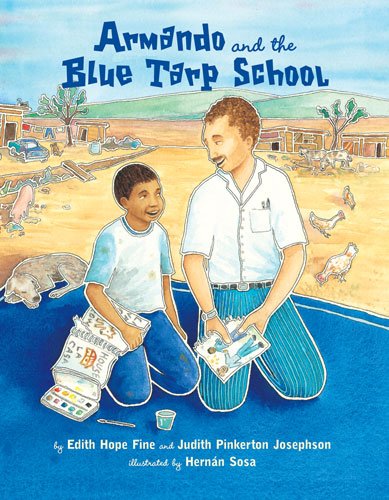
Armando and the Blue Tarp School
by Edith Hope Fine and Judith Pinkerton Josephson, illustrated by Hernan Sosa


Armando and the Blue Tarp SchoolThis book is based on the true story of a teacher who set up a school in Tijuana, Mexico with only a blue tarp. The poverty of the children is harsh, and their garbage-dump surroundings vile. But with hard work and hope, the children begin to go to school. This is a picture book, but due the theme and length is intended for school-age children. Interesting and inspirational, it manages to teach without being preachy. The real story is included at the end of the book, as well as a glossary of Spanish words.

Links to material on Amazon.com contained within this post may be affiliate links for the Amazon Associates program, for which this site may receive a referral fee.
Thursday Three: School Days

Since Booklights is closing down due to funding issues, I am going to be moving my past posts (starting with this one) over here for archival purposes. So the good news is that you’ll see a steady flow of reviews from my Thursday Three segment. The bad news is that you may have already seen them. But repetition is the strongest form of flattery... or something like that.

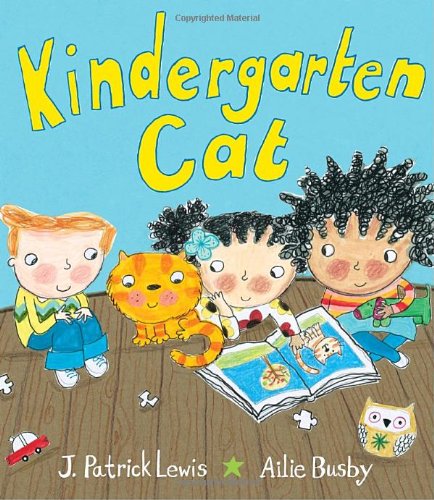
Kindergarten Cat
by J. Patrick Lewis, illustrated by Alice Busby
Kindergarten CatThe kindergarteners come to school to find that their room has its own cat — and what a smart kitty she is! She may not know her colors or numbers, but she listens to the teacher’s lessons and responds. And boy, is she cute. While many books approach kindergarten with a list of all the things kids do, this slight story allows the reader to see what happens in a more natural way. The illustrations are engaging with a childlike feel, rich colors, and a diverse class. The rhyming couplets seem a bit strained, but it’s unlikely to bother the target audience, who will be thrilled with the idea of a cat in a classroom as even a remote possibility.

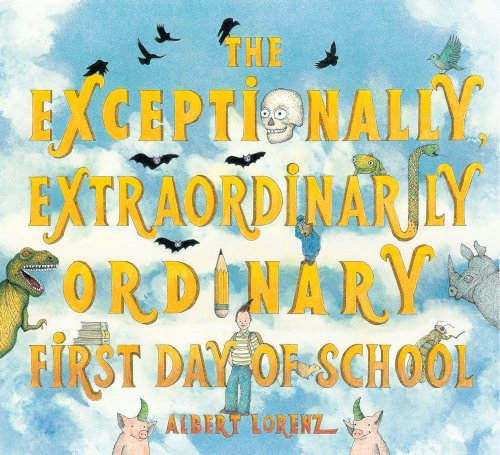
The Exceptionally, Extraordinarily, Ordinary, First Day of School
by Albert Lorenz
The Exceptionally, Extraordinarily, Ordinary, First Day of SchoolAs the new student, John, describes his old school to his new librarian, everyone gets the idea that it may not have been the least bit ordinary. Particularly the readers, who are treated to the pictures that accompany John’s often ordinary descriptions. For instance, while he simply talks about his school being really old, we can see that it is a bizarre castle with talking ravens and hungry stone lions. There is also a sidebar with definitions and facts and related notes about items in the pictures. The oddities, facts, and little jokes in the illustrations make this a fun book for older kids heading to school.

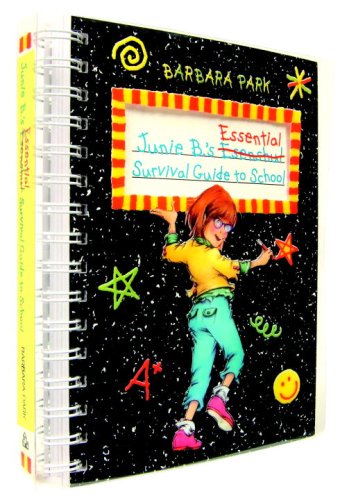
Junie B.’s Essential Survival Guide to School
by Barbara Park
Junie B’s Essential Survival Guide to SchoolWhile the Junie B. Jones books begin with her as a kindergartener, everyone knows that books titled just Junie B. indicate that she is in first grade — and so we find in this book of school tips. Fans of the series will enjoy the usual banter and antics of Junie B. (though superfans may miss the artwork of Denise Brunkus). The advice isn’t all that vital, tending more toward, “Do NOT NOT NOT pour chocolate milk from your thermos on the head of the person in front of you!” But actually, that chapter summary of riding the bus is right on target: “Sit Still, Behave Yourself, And Be Glad You’re Not Walking!” At the end of each chapter is a section for the reader to add his or her own thoughts or drawings on the topic — like favorite clothes to wear or funny ways to get to school. Overall, the book isn’t — despite the title — an essential Junie B. purchase, but is a fun way to approach back-to-school with a light touch and a bit of learning. (Because the little parent secret of Junie B. is to see what NOT to do so as to learn and discuss what one SHOULD do.)

For more back-to-school books, look at this earlier Booklights post.

Links to material on Amazon.com contained within this post may be affiliate links for the Amazon Associates program, for which this site may receive a referral fee.
“To Lie About Why Your Child Is Absent, Press 1”

Apparently, this is a real answering machine message for a school in Australia. Even if it’s not authentic, the concept itself makes it funny enough to share. Enjoy.


Hilarious School Answering Machine
Watch more funny videos at Break


Edited to add: Definitely not true, according to Snopes, but I’ll bet a lot of teachers wish it were true. Still funny, though.
Category: 3 comments