105 Ways to Give a Book

“Don’t Let the Pigeon Win This App!”

It is time to make good on my promise to give away a copy of Don’t Let the Pigeon Run This App! Last night I took all of the entries, created one list, and read them to my family. TeenReader was the prime audience, with both her fine-tuned sense of humor and her tendency to literally roll on the floor laughing. A tendency that could only be more pronounced given her lack of sleep during her play performance week.

As I pulled the list together, I found patterns among the titles. There was inadvertent poetry:
Don’t Let the Pigeon Dance with the Stars!
Don’t Let the Pigeon Fly to Mars!
Don’t Let the Pigeon Fly Over Your Head!
Don’t Let the Pigeon Become One of the Undead!
Which we will consider my contribution to Poetry Friday, hosted today at The Opposite of Indifference. There were the cautionary tales:
Don’t Let the Pigeon Write My Tax Refund!
Don’t Let the Pigeon Give Root Canals!
Don’t Let the Pigeon Plan your Wedding!
Don’t Let the Pigeon Anywhere Near the Oval Office!
All very practical advice. There was a layered, meta response:
Don’t Let the Pigeon Write a Children’s Book!
It invokes BACA, Bloggers Against Celebrity Authors, with the notion that now that the Pigeon is a celebrity, we would be against him writing a children’s book. But he’s in a children’s book, so how does that work? I know. We just blew your mind.

A holiday entry caught our eye for its creepy cleverness:
Don’t Eat the Pigeon for Thanksgiving!
But in the end it was less wordplay than imagery that tickled our funny bones. The winner of the app is Joanna Freeman for:
Don’t Let the Pigeon Learn the Bagpipes!
While the visual sold this, word choice is important in its humor. “Learn” here is funnier than “play,” because we assume an ineptitude on the part of our feathered friend, which is funny. Bagpipes is (are?) a great choice, being a silly-looking instrument that gives an instant visual. It also could be a rather annoying instrument, which plays nicely against our Pigeon — who considers annoyance a personality trait. It also would be a brilliant title to include in the actual app or a new book. I can picture it. Can’t you?

Thanks to everyone for playing, tweeting, and promoting the contest. And thanks to Mo Willems for giving me my first app. I’ll never forget it.

Links to material on Amazon.com contained within this post may be affiliate links for the Amazon Associates program, for which this site may receive a referral fee.

One Shot of City Living: Blackout

I’ve never understood the prevalence of farm books for youngsters. Most kids today don’t have daily encounters with cows and pigs. Why then do we ignore the animals of the city? Your squirrels, mice, and pigeons. (Okay, one Pigeon isn’t ignored, and in fact has his own app which you can win for free because it’s really cool, but that’s another post that you should go to. Really.) Besides featuring the farm, picture books are drawn to the countryside setting. Pastures, forests, trees, all sorts of nature everywhere.

Well, it is high time for the city to rise to take its place in children’s literature. With three quarters of the population living in urban/suburban areas, kids can relate to street noises as much as cricket songs. They get cars and trucks and things that go. Here’s another thing: They don’t require a moral tale of how busy/loud/scary the city can be compared to the calm serenity of the countryside. (I’m looking at you, Town Mouse.)

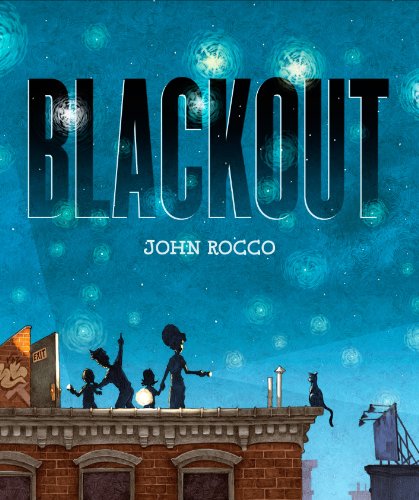
BlackoutYou won’t get that in my featured book for the One Shot of Book City. Blackout, by John Rocco, is both a tribute to the city and a nod to serenity. The story takes place in New York during the famous 2003 blackout. A family is dispersed throughout the house enjoying their God-given right to electricity, when BAM! Power’s out. Everywhere. They head to the roof to escape the summer heat and find the stars filling the night sky and neighbors socializing and it’s all simply fun. When the lights come back, they’ve remembered that sometimes they can have fun without electricity — even when they aren’t forced to do so. The city and the family can return to normal, but keep a little of that special time alive. Let me just interject how much I love the family here. A realistic group with mom busy on the computer and older sister on the cell phone, they also have a look of unspecified racial diversity.

The book is laid out in a modified graphic novel style, though with narrated text as opposed to dialogue. As such, the expressions of the people are needed to help tell the story. The surprise on the family’s faces as they look out on a darkened city. The boredom as they sit around the table expecting the electricity to come back. The stunned wonder as they come out to the roof and see stars — no small thing for city folk to see. Within the dark tones of the illustration, the stories of what becomes a sort of magical night is captured beautifully. Stories like these:


A book not to be missed, Blackout is on the New York Times Best Illustrated Children’s Books of 2011, Publisher’s Weekly Best of 2011 and is being talked about in terms of a Caldecott Award. John Rocco is a great guy, too. Check out an interview with him at Seven Impossible Things and visit his website, you know, just to say hi. Because he’s a nice guy, as evidenced by my own BEA encounter. Oh, and don’t forget to check out the other city books organized today at Chasing Ray.

Links to material on Amazon.com contained within this post may be affiliate links for the Amazon Associates program, for which this site may receive a referral fee.

Don’t Let the Pigeon Run This App!

Those who follow this blog know that I have a longtime relationship with Mo Willems... assuming that you interpret “relationship” to allow for a certain stalker-like quality. So I was excited to hear that he had created an app for his Pigeon character, and was happy to check it out for the blog readership. It’s also a MotherReader milestone — not only my first review of an app, but my first app altogether.

My virgin state allowed me to give an interesting perspective, in that I can approach the app with the same technical awareness as that of a child. Honestly, probably less than that of most tech-savy kids today. But it also means that you may need to excuse my less-than-perfect terminology. For instance, do I say that the app begins? (Yeah, I’ll go with it.)

When the app begins, the user is given the choices of “Create Your Own Story,” “Draw the Pigeon,” or “Boring Stuff.” I first selected “Boring Stuff,” figuring it might include the instructions that a novice like me might need — which it did indeed. Once I was suitably informed, I turned to the drawing option, which was introduced by Mo Willems himself, who told me, “You and I are going to do something very cool...”

Dude! We’re going to grab some Jack Daniels, hitchhike to Texas, and pants Rick Perry!!???

Turns out that we were going to draw the Pigeon together, which I suppose is also cool. The instructions were clear and made memorable by his personalizing touch, like explaining that the Pigeon’s beak is drawn by making an M for “Mo” or W for “Willems.” Making a respectable-looking drawing on the iPhone was not easy, though kids probably won’t mind (and it might be easier on the larger iPad). The resulting picture can be saved to use in the stories. (There’s also an option for drawing freely on the screen.)

Moving on to the stories, I was presented with three ways to proceed. Egg will start a story based on some interwoven elements randomly selected — just shake the Pigeon (that is, shake the iPhone) and you’re off and running. Chick gives the reader a series of choices between three things that will be incorporated into the story. So the reader will be asked to choose a food or a game or a character or a title for the book, all of which will be woven together. There were some standout choices that had humor built in, like the vegetarian chile con carne. (See, it’s funny because con carne means “with meat”!) There were several choices of title, from a standard “Don’t Let the Pigeon Rule the World” to a silly “Don’t Let the Pigeon Wear Purple Underwear.” It wasn’t clear how many options there were in total, though three were presented each time.

There is a Mad Libs element to it all, as some phrases fit into the storyline with more ease than others. When the Pigeon talks about putting you in a room full of smelly socks, it makes sense. A room full of armpits is a little more surreal. But generally, it pretty much works.

But the best option for play and humor is Big Pigeon, where the reader can record the answer to any of the incorporated elements, and the pigeon will say them in the context of the story. This is where TeenReader and I had a blast. After trying it out once, and finding that the Pigeon attributed the change in his “voice” to needing a throat lozenge, Teen had to name the next story Don’t Let the Pigeon Have a Throat Lozenge. (See, it’s funny because the pigeon ends with the very thing we told him not to do!) And we just got sillier after that, topping out with a political tale, Don’t Let the Pigeon Pants Rick Perry, where the pigeon promised us a truckload of tequila, offered to play Occupy Wall Street with us, and informed us that Herman Cain would let him do it.

We had a lot of fun with the game — with nary a kid around us — so it certainly has promise for its target audience of actual children. Personally, I’m not crazy about shaking the device to start the story, as whenever I see a young child shaking an iPhone I get very nervous. I’d also like to see more in the app. More choices of fill-in elements, and more variations in the way the whole story comes together. But I don’t know apps, so maybe I’m dreaming a little big here. At $6.99 it also seemed a bit pricey compared to other book apps, but I do admit that I tend toward the stingy and have just the vaguest notion of what a reasonable price point might be for this sort of app. (A free copy was provided to me for review.)

Overall the Pigeon app is a lot of fun, and can keep the adults tossing out new titles long after the app play is done, from TeenReader’s woeful Don’t Let the Pigeon Take Precalculus to the existential Don’t Let the Pigeon Die Alone.

Now it’s your turn. What fun titles — particularly adult but not “adult” — would you like the Pigeon to try? Put them in the comments! TeenReader and I will pick our funniest favorite in a completely subjective way and give the winner a free copy of the app. The contest will end at 8:00 p.m. EST on Thursday, November 17th, with the winner announced the next day. Have fun!

Links to material on Amazon.com contained within this post may be affiliate links for the Amazon Associates program, for which this site may receive a referral fee.

Poetry Friday: Brother Sun, Sister Moon

We praise you that in this world of hatred and war,
You still give us courageous brothers and sisters
who offer their lives to the making of peace.
They are indeed your beloved children.

— from Brother Sun, Sister Moon
Brother Sun, Sister Moon: Saint Francis of Assisi’s Canticle of the Creatures
written by Katherine Paterson, illustrated by Pamela Dalton

Chronicle 2011, review copy from publisher

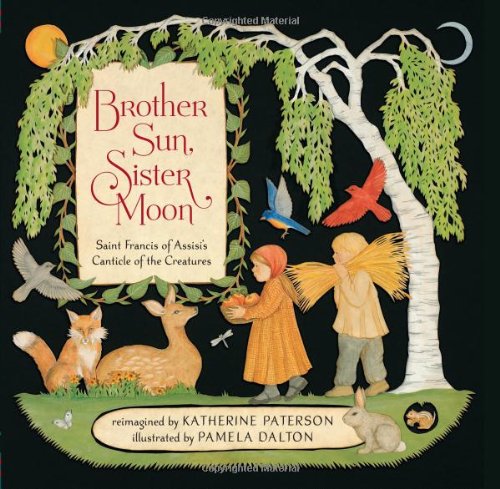
Brother Sun, Sister Moon: Saint Francis of Assisi’s Canticle of the CreaturesThe Canticle of the Creatures is elegantly reworked in accessible phrasing with detailed cut-paper illustrations. One word review: Gorgeous. Two word review: Gorgeous gratitude. The levels of beauty continue to surprise me, but I’ll admit that the book requires a patient reader. That seems like a hard sell for a picture book, and yet I see the need for this book. First in a religious context, where too often the quality of the work is lacking in favor of the message. Here we have both, with the text invoking God with sublime poetry and imagery. Fire is praised for the warmth it gives “and in whose resplendent dancing light we glimpse your playfulness.” At the same time the stunning illustrations take us through a story where wood is chopped to build fires for warmth and to bake bread. And in the artwork lies the second need for the book: an invitation to slow down. There’s a sensibility to the delicate cut-paper work where willow branches bend to the force of the wind or bow in a border echoing the downward flow of the water that begs for deliberation. In stopping to appreciate the scenes, the reader has the opportunity to absorb the words of gratitude. In a picture book age of broad strokes and quick page turns, Brother Sun, Sister Moon makes an appeal for an unhurried approach, a mindfulness within its pages that extends to the natural world beyond. Exquisite.

Poetry Friday is hosted today at Teaching Authors.

Links to material on Amazon.com contained within this post may be affiliate links for the Amazon Associates program, for which this site may receive a referral fee.

New York Times Best Illustrated Children’s Books 2011

It’s not like you haven’t seen the list of the New York Times Best Illustrated Children’s Books already, since I’m late on the uptake. But for my own records and general comfort level that I’m paying attention to such things, here they are with my little thoughts.

Along a Long Road Along a Long Road
written and illustrated by Frank Viva
(Little, Brown)
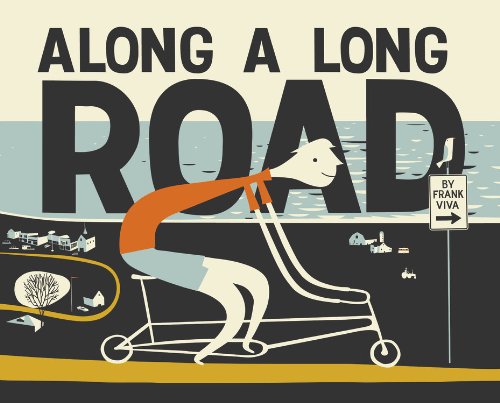
Yeah, I can see why this was chosen. Interesting art, though not one of my favorite books this year.

A Ball for Daisy
written and illustrated by Chris Raschka
(Schwartz & Wade)
Generally I don’t love Raschka’s art, but I liked it here. The loose style of his work matches the playfulness of a puppy very nicely.

Brother Sun, Sister Moon: Saint Francis of Assisi’s Canticle of the CreaturesBrother Sun, Sister Moon: Saint Francis of Assisi’s Canticle of the Creatures
written by Katherine Paterson, illustrated by Pamela Dalton
(Chronicle)
Simply gorgeous!

Grandpa Green
written and illustrated by Lane Smith
(Roaring Brook)
Clever, touching, and brilliant in concept and illustration.

Ice
written and illustrated by Arthur Geisert
(Enchanted Lion)
Really? The book with the pigs? Okay, I guess.

I Want My Hat Back
written and illustrated by Jon Klassen
(Candlewick)
Still trying to get on board with the hype on this title. Also, while I like the illustrations I don’t think it falls into the best illustrations of the year.

Me...JaneMe… Jane
written and illustrated by Patrick McDonnell
(Little, Brown)
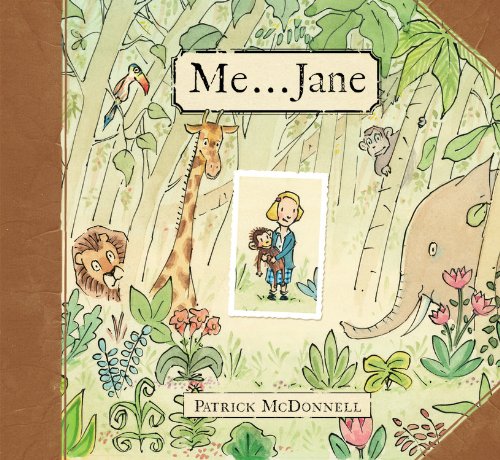
Honestly, my favorite parts of the illustrations are the old engravings used under the text. But I like the book and like McDonnell’s work, so I give it my seal of approval.

Migrant
written by Maxine Trottier, illustrated by Isabelle Arsenault
(Groundwood Books)
Don’t know this one.

A Nation’s Hope: The Story of Boxing Legend Joe Louis
written by Matt de la Peña, illustrated by Kadir Nelson
(Dial)
Or this, but it is Kadir Nelson who is probably contractually obligated to be listed whenever best illustrator lists are made. And rightly so.

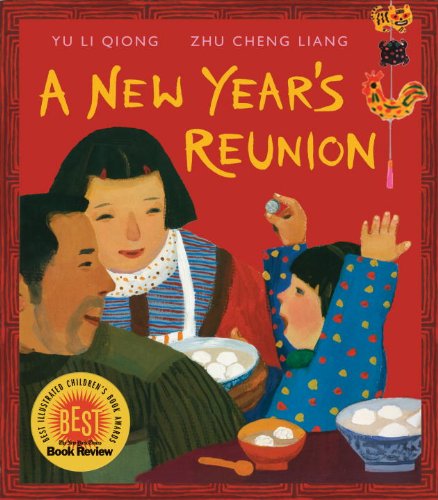
A New Year’s ReunionA New Year’s Reunion
written by Yu Li-Qiong, illustrated by Zhu Cheng-Liang
(Candlewick)
Don’t know this one either, but it just came out a week ago, so I shouldn’t have to take the blame for that.

As I’ve been making my way through the Cybils-nominated picture books, I’ve come across some favorites that I would have liked to see on the list. Books like Blackout, by John Rocco, Blue Chicken, by Deborah Freeman, and Naamah and the Ark at Night. Since I don’t know the last three books anyway, in my head I’ll be replacing them with my selections.

Links to material on Amazon.com contained within this post may be affiliate links for the Amazon Associates program, for which this site may receive a referral fee.

Cybils FPB Nominees: Over in the Meadow

Over in the Meadow
illustrated by Jill McDonald, sung by Susan Reed

Barefoot Books 2011, review copy from library

Over in the MeadowIf you have young kids or work with young kids or ever had or worked with young kids, you’ll know the song “Over in the Meadow.” You are also likely to know of at least one picture book adaptation. If you are a librarian, you certainly know about many. Therein lies my only real complaint about this book, being that I’m not sure that we needed another one. The illustrations are bright, cute and were created “digitally using collected and painted papers.” That’s from the endnotes which I very much appreciated, as I would like something in every picture book that talks about the medium of the artwork. (Send message.) The last pages of the book contain a little information about meadows and each animal featured — which are mostly the standards, with a bit of switching to include sheep instead of frogs and mice for crickets. Like many other versions, this one includes the music notes for those among us who want to play along and has a CD with an upbeat, country sound. Overall, it’s a cute enough book; I’m just not sure if it was necessary.

Links to material on Amazon.com contained within this post may be affiliate links for the Amazon Associates program, for which this site may receive a referral fee.

STEM Friday: Science and Stories Program

There’s a new meme in town. STEM Friday focuses on books that promote Science, Technology, Engineering, and Math. The round-up this week is hosted at Simply Science.

Over the year I’ll be sharing the preschool program I created for the library and that I’m presenting once a month. The concept behind the program is to introduce science topics by combining fiction and nonfiction, songs and mini-experiments, action rhymes and hands-on times. The target age for the program is three to six years old, so the information conveyed is basic, and intended to encourage a questioning, observational approach to scientific topics.

Measuring

Book: Kidogo, by Anik McGrory

Experiment: “Big or Little”
Hold up various objects – pencils, stuffed animals, etc. — and decide as a group if they are big or little. What do we have to consider? Comparison? The use of the object? Standard sizes of the object? What makes something big or little? This exercise shows that description is subjective, and we need more standard ways of measuring.

Book: How Long Is It? by Donna Loughran

Experiment: “I Need an Envelope”
Each child has a card and needs to order an envelope of the right size. The child measures the envelope with any of the following units: fingers, paper clips, or pencils. The instructor fills the order, but the envelope doesn’t fit. Why not? Because the adult filling the order has a bigger finger, smaller paper clip, and smaller pencil. This exercise demonstrates why standard measuring systems are needed.

Book: Measuring Penny, by Loreen Leedy

Experiment: “Types of Measuring”
Show different items and ask the group what they measure. Things like a measuring cup & spoons, a scale, a thermometer, a ruler, measuring tape, a scale, etc. What else measures?

Book: Magnus Maximus, a Marvelous Measurer, by Kathleen Pelley

Experiment: “How Big Is It?”
Hands-on time to measure different items. Each child has a paper ruler (look online for templates) and a pencil. Six items to measure are a pencil, an envelope, a card, post-it notes, a book, and paper clips. This is also time to explore the other measuring items from “Types of Measuring.” Have beads and pom-poms for the measuring spoons and cups, let the children measure each other with the tape, and weigh themselves on the scale. (Put away the thermometer before somebody sticks it in his mouth. Lesson learned.)

Links to material on Amazon.com contained within this post may be affiliate links for the Amazon Associates program, for which this site may receive a referral fee.

Thursday Three: Bitchy Version

The Picture Book Manifesto said that picture book authors and illustrators “need more robust criticism” and I’m feeling bitchy anyway, so here goes.

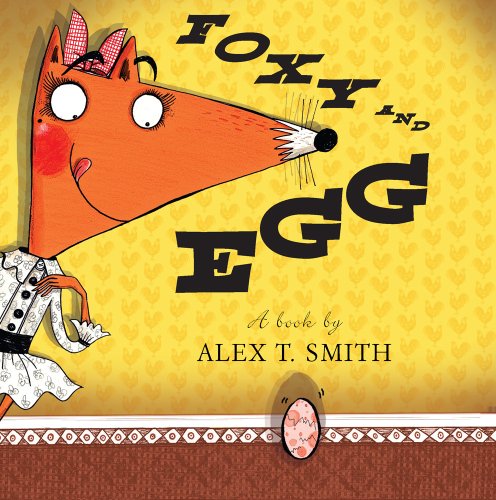
Foxy and Egg
by Alex Smith

Holiday House 2011, review copy from library

Foxy and EggAn egg visits Foxy, who hopes to fatten it up to eat the next day but gets a big surprise instead. Okay, it’s an egg visiting. An egg. An egg doesn’t visit or fatten up or play parlor games for exercise. It doesn’t grow huge overnight to crack open as a full-grown crocodile. Because it’s an egg. I’m getting that this is supposed to fall into the realm of the silly, but doesn’t pull it off and just seems like a dumb concept from the start. Maybe the story was supposed to be a takeoff on the crocodile and the hen folktale, which actually makes sense and is done quite well in Mrs. Chicken and the Hungry Crocodile. Honestly, I’m not crazy about the mixed media illustrations either, but it’s the story here that lacks cohesion and loses me at the first premise with that stupid egg.

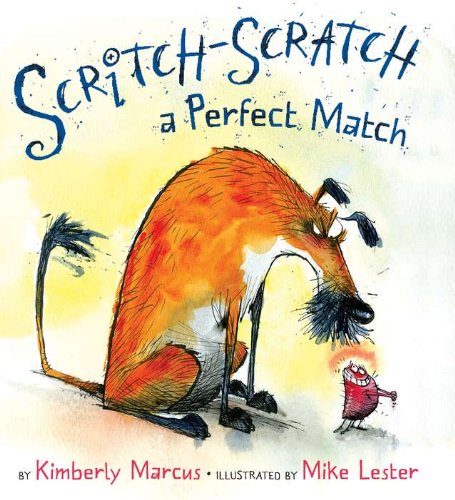
Scritch-Scratch, a Perfect Match
by Kimberly Marcus, illustrated by Mike Lester

Putnam Juvenile 2011, review copy from library

Scritch-Scratch, a Perfect MatchA flea biting a dog sets up a series of events that brings the dog to an owner and an innocent cat to harbor the flea. The story was slight and yet fairly illogical. Why does one flea drive this dog insane? Why does a random person feel the need to take care of this dog that just knocked him in the mud? What did the cat ever do to deserve this? The rhyming verses weren’t great either, as rhyming verses rarely are. But the illustrations seem ill-conceived for a picture book, being, well... ugly, with huge noses, bulgy eyes, and exaggerated expressions. The pen-and-ink outlines are surrounded by unfocused explosions of color in a distracting way that sometimes makes it hard to tell what is pictured. I’ve liked this illustrator in Ninety-Three in My Family, but this title misses the mark. The text might have squeaked through with more charming illustrations, but neither here can save the other.

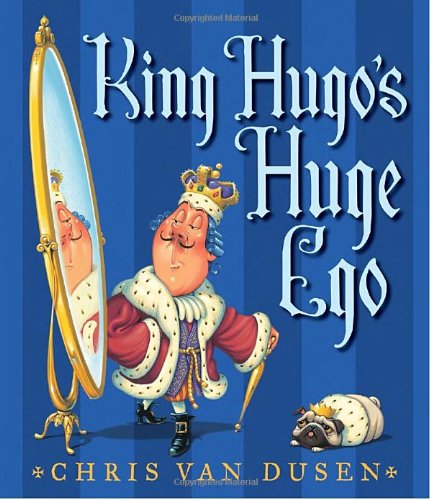
King Hugo’s Huge Ego
by Chris Van Dusen

Candlewick 2011, review copy from library

King Hugo’s Huge EgoA king with a huge ego pushes a maiden out of the roadway, causing her — as a sorceress in disguise — to put a spell on him to have the size of his head reflect his arrogance. His head grows so big that it catches the wind and blows him away from the kingdom to the feet of the girl, who deflates him with knowledge of his wrongdoing. His instant regret of his actions makes her fall in love with him and marry him. The End. Obvious message? Check. Rote ending? Check. Bad rhyming? Check. And let’s add the image of the king’s head growing grotesquely large as an image that nightmares are based on. I may be alone in my dislike of this title given the Amazon reviews, but again, I like the author/illustrator’s other books — like The Circus Ship — far more. I was really ticked that the maiden married the king, because yeah, that’s how fairy tales end, but this was no fairy tale. Better she become his therapist at an outrageous hourly fee and buy her own manor. Woman power!

Links to material on Amazon.com contained within this post may be affiliate links for the Amazon Associates program, for which this site may receive a referral fee.

Picture Book Month

There is indeed a movement to make November a time to celebrate children’s literature with Picture Book Month. Led by author Dianne de Las Casas, the website will feature essays of notable authors and illustrators, along with resources, activities, and referrals. As the organizer for the Cybils category for picture books, I could certainly get on board with such fantastic idea. As it turns out, I was already planning to fill this blog with reviews of the many, many, many Cybils-nominated titles in my category. So look for that.

It’s also good timing that I can start today with a proclamation, but even better that it is written by someone else. Especially if that person or people should have particular regard for the topic. People like authors and illustrators of children’s books, like Mac Barnett, Sophie Blackall, Carson Ellis, Adam Rex, Jon Scieszka. Something like this:


While I’m not sure I agree with all aspects of the manifesto — I don’t mind the term “kid-friendly,” for one — I love the concept. The website is getting a lot of attention and hopefully starting some conversations. With my idea to talk more about the many (many, many) books nominated for the Cybils this year, I’m taking another look at one line of the manifesto: “We need more robust criticism to keep us original.” Are you sure? Really? ’Cause I could give it to you, but it won’t be nice...

Links to material on Amazon.com contained within this post may be affiliate links for the Amazon Associates program, for which this site may receive a referral fee.

Happy Halloween

I’m so confused today. Should I post a Halloween book review or something for Nonfiction Monday? Or continue my coverage of the Cybils-nominated picture books? Talk about October’s Carnival of Children’s Literature? Decide whether to get in on NaNoWriMo?

It’s all too much, so I’m just going to give you a picture of the pumpkin that TeenReader did, with me helping on the tricky parts with an X-Acto knife. Shout-out to the great stencils at Zombie Pumpkins.


Do you know who it is? Answer with a reference from the movie in the comments. Happy Halloween and watch out for zombies!

Links to material on Amazon.com contained within this post may be affiliate links for the Amazon Associates program, for which this site may receive a referral fee.
Category: 3 comments

Cybils FPB Nominees: Monsters

If you are heading to the library now for your Halloween books, you are likely out of luck. Those Halloween-themed titles are long gone. But all is not lost if you expand your search to books about monsters:

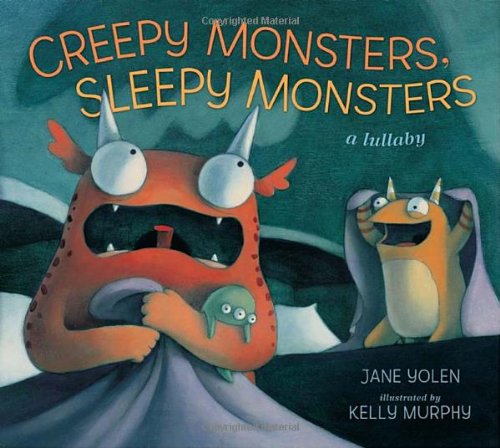
Creepy Monsters, Sleepy Monsters
by Jane Yolen, illustrated by Kelly Murphy

Candlewick 2011, review from library copy

Creepy Monsters, Sleepy MonstersA simply worded lullaby about monsters everywhere will captivate young readers. The rhyming text is sparse, putting the attention on the perfectly detailed illustrations. And perfect they are, being both a bit creepy and cute at the same time. The soft palette and gentle acrylic paintings make even the multi-eyed monsters adorable. The friendly expressions and familiar settings — like playgrounds, kitchens, and bedrooms — keep it sweetly accessible, even as the monsters chow down on worm sandwiches and burp in bed. As a read-aloud book it’s distracting that the last sound doesn’t rhyme, given the carefully constructed couplets throughout. Given the “Grrrr” it seemed logical to have a monster cat give out a calming “Purrr” at the end instead of the standard sleepy sound, “Zzzzz.” A quibble perhaps, for a nice monster/bedtime book.

Check out an earlier post for more monster picture books to find when the Halloween pickings are low.

Links to material on Amazon.com contained within this post may be affiliate links for the Amazon Associates program, for which this site may receive a referral fee.

Nonfiction Monday: Halloween Book of Facts and Fun

A quick review of a nonfiction backlist book that is perfect for the season.

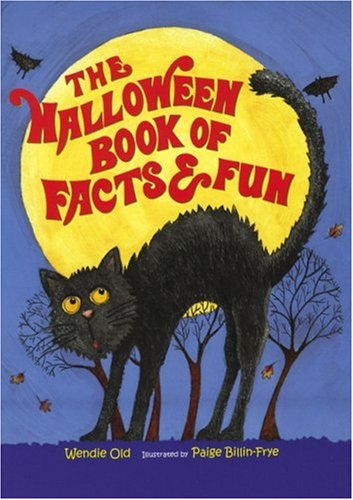
The Halloween Book of Facts & Fun
by Wendie Old

Albert Whitman and Co. 2007, review copy from library

The Halloween Book of Facts & FunEvery once in a while I find a book that makes me ask, “Where were you all my child-raising, storytime-planning, classroom-reading years?” What I love about this book is right there in the title — it’s facts and fun. There are instructions for carving a pumpkin and having a Halloween party. There are safety tips and riddles. There are chapters about traditions, witches, jack-o-lanterns, Dracula, and more. There’s even a full-page bibliography if you want to expand your Halloween research. It’s the kind of book that you can pull out each season, whether at home or a classroom or a library, which is why I can’t believe that I wasn’t able to benefit from its perfection for all those years. Starting now, you can plan to dole out a chapter or so a day in the build-up to the Big Event.

Nonfiction Monday is hosted today at Apples with Many Seeds.

Links to material on Amazon.com contained within this post may be affiliate links for the Amazon Associates program, for which this site may receive a referral fee.

Cybils FPB Nominees: Dots and Squares

Sure you can fill your picture book with all sorts of fancy art, but there are others who take a simpler approach. And it’s hard to get more basic than a dot and a square.

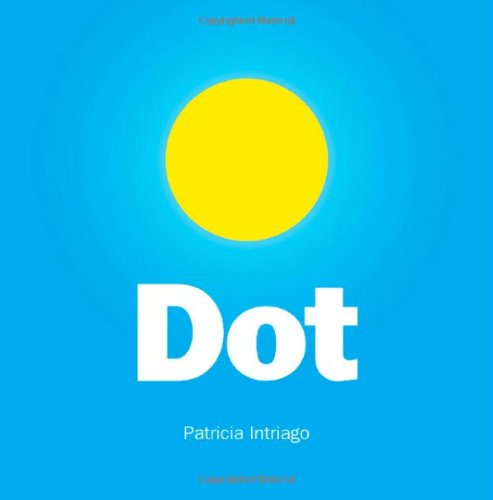
Dot
by Patricia Intriago

Farrar, Straus and Giroux 2011, review copy from library

DotGraphically bold, the simple dot is used to illustrate concepts and opposites. Starting with color changes of the stoplight to show stop and go dots, the design becomes conceptual to describe other ideas. The loud dot has a big pie shape cut out to represent an open mouth while the sad dot is shaped like a teardrop. A few photo images make appearances to show hands poking the hard and soft dot, and then a clearly dotted dalmatian and a not-dotted zebra. The text doesn’t always rhyme or follow a rhythm. That, along with the surprising change to photos in the two spreads, marred the book’s consistency for me, though I can see how others would appreciate those touches that leave the reader a bit askew. In all, a decent early concept book, but not one that I can imagine becoming a much-loved title.

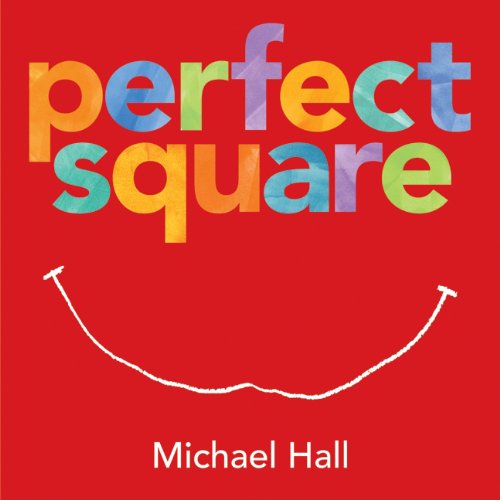
Perfect Square
by Michael Hall
Greenwillow Books 2011, review copy from library

Perfect SquareThrough a week, a perfect square goes through transformations, becoming cut, torn, shredded, shattered, snipped, and crumpled. Many squares would get annoyed at this treatment, but this square makes the best of it by turning itself into lovely pictures of flowers and mountains and such. At the end, the various pictures come together into one story in one imagined scene of all the colors of the rainbow. Personally, I would have liked to see the whole scene put together at the end — though I can guess that it wasn’t so easy. Also, I was confused by the idea that it was “a” perfect square. How does one square get pulled apart each day and also change color? I may be over-thinking here, but it did annoy me. But I’m peevish that way.

Links to material on Amazon.com contained within this post may be affiliate links for the Amazon Associates program, for which this site may receive a referral fee.

Cybils FPB Nominees: Cats

As I negotiate the peace between our old cat and our new cat, I’m probably particularly attuned to the feline nature. Though really, I’m always a sucker for picture books about cats, and these two Cybils-nominated titles set me purring. Figuratively, that is.

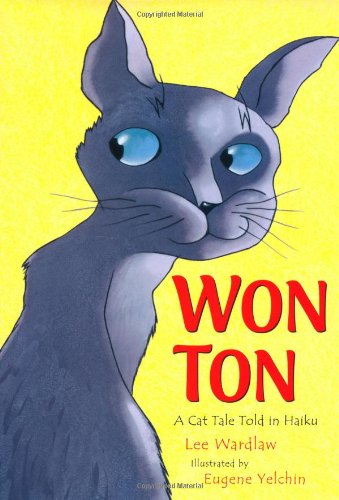
Won Ton: A Cat Tale Told in Haiku
by Lee Wardlaw, illustrated by Eugene Yelchin

Henry Holt and Co. 2011, review copy from library

Won Ton: A Cat Tale Told in HaikuThis isn’t your schoolroom haiku. Or even technically haiku, which focuses on nature and seasons. But here the author notes that we are looking at a series of senryu, a form that focuses on human nature. Or cat nature. In the book we are introduced to a lonely shelter cat, lean and longing, who gets a home and adjusts to his new surroundings with the typical practiced nonchalance and semi-disdain exhibited by the feline. “Hel-looo. I’m waiting/Put down that pesky pencil/and fetch the catnip.” Poems cover fishy breath, scratching furniture, and hairballs along with the cuter aspects of cats. The illustrations keep the focus on the feline, tuning out the backgrounds in soft colors, and capturing the essence of each poem and its subject. The sparse text will make it suitable for reading aloud to preschoolers, but the subtleties of the poetry will take the title well into elementary school with fun for all along the way.

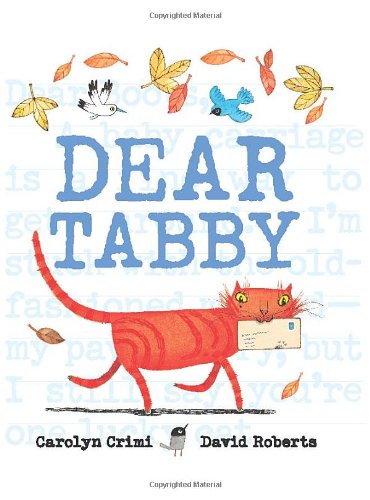
Dear Tabby
by Carolyn Crimi, illustrated by David Roberts

Harper Collins 2011, review copy from library

Dear TabbyAn alley cat sets up an advice column for animals, responding to the problems of a parrot, the distress of a dog, and the grumblings of a groundhog — among many other animals. Tabby D. Cat gives good suggestions, some of which could apply in broader, human situations — touching on listening, acceptance, and gratitude. Other than some puns, the advice itself isn’t silly, with the humor conveyed in the situations, the illustrations, and the ultimate resolutions. In the end, the advice offered to one overly pampered cat brings the helpful tabby a new home. Animal lovers of all stripes will appreciate the clever scenarios and engaging pictures. With a fair amount of text and lots to enjoy on every page, this book is a great choice for elementary school kids. Adult readers may also appreciate the actual advice, which ends the books with this letter to a mournful dog: “Well, sometimes happiness is right there beside you. You might even be passing it on your daily walk! But a lot of times you have to make happiness happen. Sniff it out, hunt it down, dig dig dig until you find it.” Good words for all of us!

Links to material on Amazon.com contained within this post may be affiliate links for the Amazon Associates program, for which this site may receive a referral fee.

Poetry Friday: A Full Moon is Rising

Tomorrow is the last day to nominate books for the Cybils, and no category needs your support more than poetry. I tried, but all of the books that I suggested were already nominated. So someone with some expertise needs to find those missing books and get them on the list, as I am sure that there were more than thirty titles published in children’s and Young Adult poetry last year. Go. Nominate.

A Full Moon is RisingMy personal favorite is A Full Moon is Rising, with poems by Marilyn Singer and illustrations by Julia Cairns. Honestly, I could almost stop at just framing the cover, but then I’d miss the world travel offered by the verse, which takes the reader from the moon over New York City through the sands of Morocco to the seas of the Caribbean out to the reaches of space and back again. The poems nicely capture the different cultures under the moonlight and specific activities honoring its glow, while engaging illustrations perfectly display the diverse world. With supplementary material including a highlighted world map, lunar phases, and descriptions of the areas, the book ventures into the territory of indispensable for personal and classroom use. In tribute to my own New York City love, here’s the first poem:
Broadway Moon

It waits behind skyscrapers,
a brilliant actor in the wings,
ready for its monthly debut.
One the sidewalk, and audience of one
watches and silently applauds
when it grandly appears.
Today’s Poetry Friday is hosted at fomagrams. And don’t forget your Cybils nominating!

A Full Moon is Rising
by Marilyn Singer and illustrated by Julia Cairns
Published by Lee & Low Books, 2011
Copy provided by publisher

Links to material on Amazon.com contained within this post may be affiliate links for the Amazon Associates program, for which this site may receive a referral fee.

KidLitCon Seattle: Sessions and Stuff IV

Well, this is embarrassing. I thought I’d finished and posted this and have not been paying enough attention to notice that was not the case. Kinda shows how things have been going lately. While I could be critical of myself, I will instead focus on the session I attended on critical reviews. (See what I did there?)

Presented by Kelly Jensen and Julia Riley in the room and Abby Johnson and Janssen Brandshaw through the wonders of technology (Skype, I mean. They weren’t like robots or anything.), the session took on what we’ve only spoken about in whispers: What if the book isn’t good? The team immediately reframed the conversation from “negative” to “critical” reviews, putting the emphasis on analysis of the book. They covered ways to pull out discussion of pacing, characters, dialogue, plotting, language, phrasing, voice, and content. They reminded us of the need to notice and address whether to share specific content or spoilers, and to think of the audience of both the book and the review in making these decisions. The talked about avoiding snark, which is a little sad for me as my best line is from reviewing a glittery picture book and stating that my hands looked like I had bitch-slapped Tinkerbell.

Jen Robinson and Carol Rasco did a great job covering the many ways to get your blog out into the eyeballs of readers. Jen went through subscriber emails, newsletters, Facebook, Twitter, and Feedblitz. She also talked about following lists and keywords on Twitter — like #kidlit and #cybils — to keep in and be part of the conversation. Carol talked about her own rule-breaking experience in her organization blog for Reading Is Fundamental.

The last session of the day was highly energized, both by the topic of diversity and by the moderator, Lee Wind. With incredible authors Brent Hartinger, Sara Ryan, Justina Chen, and Sarah Stevenson. The panel discussion started with the provocative question, “Who has the ‘right’ to write a minority story?” And it stayed with that honest tone throughout, pointing me to resources like Writing the Other and Microagressions.com. It gave me the idea that what is dangerous about a stereotype is that it is a single story that limits, while putting out a multitude of stories expands the experience for the reader. There was much talk about speaking your own truth, and yet also turning to research. Honestly, this is an incredibly hard session to capture as the discussion, the fact that we can have the discussion, was a huge component in itself.

The day ended with a pre-dinner happy hour, where I spent some time with Amber Keyser, writer of AngelPunk. Very interesting lady, and just as game as I was to move the discussion over toward Scott Westerfeld. I mean, literally move over to where he was, as opposed to discussing him (though Els discusses his speech very well at Tor). You don’t have a writer that cool, that interesting in your midst and not try to engage him. (I had made a good attempt at lunch as well, but it’s never enough.) We chatted books, New York City, and celebrity encounters before heading to dinner. I sat with my old crowd, but did chat with Martha Brockenbrough, though not nearly enough. After dinner, it was back to the lounge for more wine and hanging out (though sadly, no more Scott Westerfeld) and yes, one more drink at the KidLitCon Command Center before officially closing out the day and the conference.

Thanks to Colleen and Jackie for all the work that went into putting KidLitCon Seattle together! See you all next year at KidLitCon NYC!

KidLitCon Seattle: Sessions and Stuff III

When I heard that Scott Westerfeld was going to give the keynote for KidLitCon Seattle, I was excited because he’s a big name in YA and an interactive blogger. But I wasn’t personally a fan, thinking that his books were not my style. Then I heard his presentation and was absolutely mesmerized.

He talked about the death of illustrations in books at the hand of the camera. Illustrated panels had been common in books before a new pricing structure for illustrators fell into place, leaving publishers taking the cheaper road to text only, even for children’s books. He talked about the mindset of adults changing to promote these books to kids as chances to use their own imagination to create the pictures. (And I’ve used that line myself, and now it does seem like a line.)

With the Leviathan series, Scott Westerfeld wanted to bring back the idea of illustrations in a book intended for an older audience. He described the process of working with the illustrator to create the world portrayed in the series, even to the times the artist drove aspects of the story by getting ahead of him. He was influenced by fan art of his other books to realize the importance of the illustrations and also to some of what the readers wanted to imagine in the books. In his words, “That which the camera took away was given back to us through the Internet.”

Honestly, after this talk I was a little bit fangirl and made sure that I table-hopped his way during lunch. He was just so interesting. I also bought a copy of Leviathan to have signed to my teen. So just an aside to authors that there are ways to sell your book without SELLING YOUR BOOK.

The next session I attended was The Fantastic New World of Book Apps for Children presented by Mary Ann Scheuer, Betsy Bird, and Paula Wiley. They showed various book apps and explained specifically what made them good — and just as helpful, what made them not good. In evaluating book apps, it’s important to look at what moves the story forward or enhances the experience or the learning. Some apps have received good marks, and yet take the reader out of the story by engaging them to draw pictures on an unrelated screen. For more on evaluating book apps, head to Great Kid Books, the blog of one of the presenters and the organizer for the Cybils new category for book apps.

While I didn’t expect to do more than sit back and get an author’s perspective on marketing, I found myself taking copious notes during Holly and Shiraz Cupala’s presentation. They shared the concepts and strategies behind marketing Tell Me a Secret, including blog tours, trailers, videos, and a two chapter booklet. They shared the application of the four Ps of marketing: Product, Price, Place, and Promotion — which was noted from the other side as Consumer, Cost, Convenience, and Communication. It was an amazing presentation, and I’ll direct you to the Holly Cupala’s website for more information or to book this duo for a presentation near you. Seriously. I will leave you with this tidbit though: Over 75 pecent of children’s books are bought in a store. Just 12 percent of teens shop for books online. Interesting, huh?

Links to material on Amazon.com contained within this post may be affiliate links for the Amazon Associates program, for which this site may receive a referral fee.

KidLitCon Seattle: Sessions and Stuff II

Sure, lots of people like to talk about the conferences that they attended while everyone still remembers that there was a conference. But while everyone is moving on to Cybils nominations, I’m still here throwing out updates. Let’s say it’s because I want to keep talking about it. You know, as opposed to me being lazy about writing this week.

Anyway, I left my updates after only the first session. I sat for the second session — The Future of Transmedia Storytelling — with no preconceptions about the subject. And boy, did that panel blow my mind! In case you are wondering about the topic, as I kinda was, I’ll give a definition. And since I can’t remember if this was their words or my notes, I’ll put it in quotes to be safe. “Transmedia refers to the delivery of story through a variety of media. Story lines are interwoven and connected, but not repetitive. Each story element is individual, but true transmedia brings things together as one concept.” The Angel Punk group described several types and versions of transmedia. I noted the following: Pottermore, 39 Clues, Inanimate Alice, iDrakula, Cathy’s Book, and Skeleton Creek. Being the creators of Angel Punk, they talked the most about that as a combination of film, comic book, novel, and interactive experience with blogs, Facebook pages, and Twitter feeds for the characters. I had no interest in this stuff before, but I am really curious now and can’t wait to investigate.

After that session, it was lucky that I went to one on blogging the backlist. Here I could settle in with the comfort of a cozy couch on a winter day, because I’m all about the backlist. Especially now that I realize that six months from publication is backlist! Seems surprising that that shiny new book isn’t all that new anymore in the publishing industry. Here I didn’t take notes so much as raise hands and shout Amen as Jen Robinson, Melissa Madsen Fox, and Maureen Kearney led the discussion on how both old and new books are important for librarians, for awards, for readers, for each other and for publishers. I say it again: AMEN!

With lots of activity and little sleep, I hit the wall before the next session and had to retire to my room. I was so tired that I missed the free wine in the lobby. Missed. The free. Wine. So I can say that I was completely sober as I attended the Meet-and-Greet that evening, and yet I remember almost nothing about it. I know I saw some friends and conversed with Melissa, Sondy, and Farida. I remember that the appetizers were far more like a buffet than I would have expected, meaning that I did not have to scout out a late dinner. I recall a conversation with Kevin Emerson, because he seemed pretty cool at the author introductions that were done prior to the eating part. Oh, and I got to say hello to Most Popular, Lee Wind. And that’s about all I can swear to.

Now I’m off to take my Girl Scouts camping, hoping for better weather than I am expecting. With any luck I’ll finish off with the actual first full day of the conference on my third write-up two weeks later.

KidLitCon Seattle: Sessions and Stuff I

It makes the most sense to start with the session I did, even it is the one that I’m having the hardest time writing up. In order to combat my own writer’s anxiety, I’ve decided to break it down into points, and you’ll simply have to assume and/or understand that we went into far more depth at the session itself.

Bloggers and Writers and Pubs! Oh My! was a panel discussion of the relationships among the players in the kidlitosphere. Liz Burns and I, with author Kirby Larson and Little, Brown representative Zoe Luderitz, opened up the questions with what we loved, didn’t like, and wanted to convey to each other. Some thoughts then:

Writers: Bloggers love when you are engaged with the community and contribute to conversations other than publicity for your book.

Bloggers: Publishers and writers love what you do to promote their books, and while they would love a review, even a title mention is nice.

Publishers: Bloggers love when you send out catalogs with checklists — either electronically or by snail mail — as it allows them to select the items to review according to their interests and expertise and...

Bloggers: Publishers don’t like when you check off everything on that list.

Publishers: Bloggers don’t like when you send things that are way off-base.

Writers: Bloggers don’t like when you argue with their review in the comments or by email.

Publishers: Bloggers want you to understand that they are generally not paid and are doing this for their love of reading, writing, and/or community — not to get free books.

Bloggers: Publishers want you to understand that they are trying to navigate this newer world of blogging with the techniques developed from a century of print reviewing, techniques that are still evolving.

Writers: Bloggers and publishers want you to understand that your website — kept up to date, with a blog that has your name and books clearly listed — is a valuable publicity resource.

Bloggers: Writers want you to understand that there are people behind the books, people with feelings, and they’d rather not receive the tweet about your one-star review of their books.

While I would say that these are majority viewpoints, a key factor of our presentation was that it was less about coming to a consensus of answers — in fifty minutes or less — than about starting the conversations with the questions. So, I give them to back to you to discuss:
Bloggers/Writers/Publishers: What do you love/dislike/want to convey to each other?

KidLitCon Seattle: The MotherReader Experience

At the Hotel Monaco in Seattle, you can request a goldfish for your room. Um, ours died the first night.

See, that’s the kind of lead-off you can use when you let everyone else write their KidLitCon Seattle wrap-ups before you. While they talk about the takeaway theme of “relationship,” the incredible, informative sessions, and the amazing keynote address of Scott Westerfeld, I can cover the subtle, personal experience. Which was better, the scones or the brownies? (Too close to call.) Were the pens provided by the hotel adequately “clicky”? (They were.) How many slices of carved turkey can one stack on a small slider bun? (Four.)

Then there’s the goldfish thing. I was so excited when my roommate, Liz, told me that we could get a goldfish for our room. How cool, right? She turned in before me on that first Thursday night because I was helping conference organizers extraordinaire Colleen Mondor and Jackie Parker-Robinson get presenter giftees ready. (See, Colleen? I told you envelope stuffing would be involved!) When I got back to the room, I realized that our fish was swimming in an odd sidestroke unusual to a fish. I knew that guy was a goner, but not knowing any fish rescue techniques I went to bed. Liz and I woke up to find him floating on top of his tank, and both of us had to pull back on a bit of... glee. Not because we hate pets, but because it was funnier that the fish died.

And this is why I go to KidLitCon. I mean, not to kill goldfish, but to be with my people. The friends I rarely see, but who look at life and humor and books with the same feeling. Not always the same opinions, but with a rare meeting of the minds that I find few other places in real life. In fact, as I was making my way to the hotel after a long, annoying, exhausting day of travel I was swearing to myself that I would NEVER cross-country again. I went straight to the KidLitCon Operation Center (otherwise known as Colleen and Jackie’s room), and that oath disappeared from my brain as I hugged Colleen, Jackie, Liz, Jen, and Anne. Kelly handed me a glass of wine. And I was home.

Well, except that at home, I don’t pay seventeen dollars for three scallops. (WTF?) But was very grateful to my dinner companions for sharing their extras in their more normally priced and generous meals. With team spirit, we headed downstairs to the conference room to set up for the next day. Which seemed like the same day in my mind, given my jet-lagged lack of sleep and the sameness of the morning where the same collective headed off to a hardy breakfast at a diner around the corner that I scoped out for the group. I’ve never appreciated a seven-dollar omelet more. After the meal, Jen, Anne, Liz and I walked around Pike’s Market while Liz and I fine-tuned our presentation. Meaning that Liz worried that we didn’t have enough to fill the time, while I laughed at the idea that Liz and I — either of whom talk for an hour about The Giving Tree — would have any chance of dead air in our presentation.

Small break back at the hotel, and then we were on with our panel Bloggers and Writers and Pubs! Oh My! with our very special guests, Kirby Larson (Newbery Honor winner) and Zoe Luderitz (Little, Brown marketer). I feel like I’ve blanked on much of what we talked about, but have decided to piece that together in a separate post anyway. I was pleased with my introduction to the topic, which went back to the early days of the kidlitosphere, when a group of us talked about this new dynamic of reviewers, librarians, authors, editors, parents, et al. talking about books and if this coziness made us less objective reviewers. We didn’t come to any consensus then, but in a way I did come to my own conviction: If the possibility of less objectivity comes with this vibrant, unique and special community we call the KidLitosphere... I’ll take it.

And you know what? Four years later, I was saying that to a roomful of people who were there because we embraced that risk. There we were — reviewers, librarians, authors, editors, parents, et al. — continuing that discussion of how we could all work together with understanding, respect, and integrity. Some of us had traveled thousands of miles to be part of that conversation, and online we keep talking, adapting, and refining those relationships.

Among our community, we find real friends. Later we may laugh with those friends about the goldfish that died in our care. And we get another goldfish. Her name is Natalie, and I believe that she is doing just fine.

Links to material on Amazon.com contained within this post may be affiliate links for the Amazon Associates program, for which this site may receive a referral fee.