105 Ways to Give a Book
Showing posts with label Nonfiction Monday. Show all posts

Nonfiction Monday: Parrots

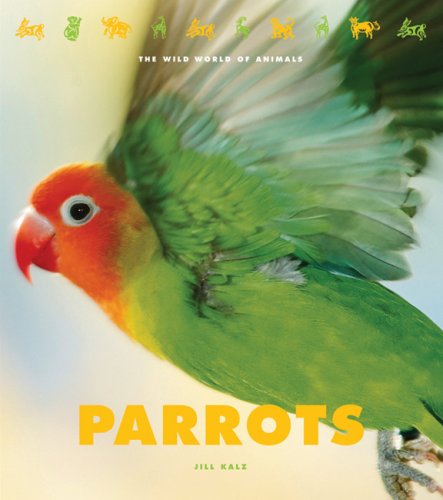
Ten years ago, nonfiction books about animals would feature a block of text on one page with a second-rate photo on the opposite page. Then came the trend — still popular — of having several text boxes, a few photos, several captions, and maybe a “fun facts” box — the busy look catering to the short-attention-span crowd. But in the last few years a new generation of books is putting more focus on the photos, with amazing results. I’ve blogged about the Nic Bishop books and the Face to Face series, but here’s another find from my local library.

Parrots (The Wild World of Animals)
by Jill Kalz

ParrotsThe text is pretty standard, informational stuff — but the photos are spectacular! One huge, stunning, no-borders, full-page picture, with text in a box over the photo itself. Some of the pictures fill up the two-page spread. Now with a subject as colorful as parrots, this style is exceptionally stunning, but you’ll also relish the chance to explore many other topics in the series, The Wild World of Animals, including koalas, lions, dolphins, swans, and giraffes. The series has been around for a while, so you’ll want to look at the redesigned books published in 2006 or later. Here is an Amazon link to that listing.

Nonfiction Monday is hosted today at Ana’s Nonfiction Blog

Links to material on Amazon.com contained within this post may be affiliate links for the Amazon Associates program, for which this site may receive a referral fee.

Nonfiction Monday Host

Why, yes. I am the Nonfiction Monday host this week. Please leave your links in the comments and I’ll update this post during the day.

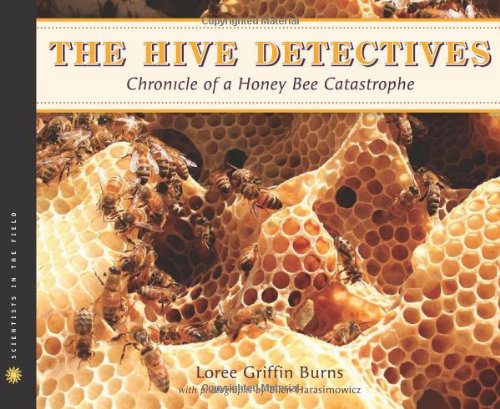
The Hive Detectives: Chronicle of a Honey Bee CatastropheFor my part, I’ll be talking about The Hive Detectives: Chronicle of a Honey Bee Catastrophe, by Loree Griffin Burns. I specifically didn’t use the word “review,” as I don’t think that I can fairly review a book that I’ve followed from the beginning research to book reviews to photo choices to title selection and onward to the publication celebration. I feel like I’ve watched this puppy grow up in front of me, and I’m just so darn proud.

Three years ago, I was vaguely interested in the whole disappearing bee thing, having seen an article or two about it. That curiosity corresponded nicely with the bee research on Loree’s blog. Intrigued, I took her book suggestion and read
Fruitless Fall, which has become one of my favorite nonfiction book recommendations. Since then I’ve been eagerly awaiting The Hive Detectives, wondering how to bring a topic to kids that seems obscure — at least in the standard nonfiction publications on dinosaurs, planets, and Abraham Lincoln. (I know, Lincoln books were sooo last year.)

As it turns out, you take the topic to kids by bringing them along on the research. Letting them meet a beekeeper, inspect a hive, visit an apiary, and autopsy a bee all through the magic of words and photography. And boy, is a photo of a cut-up bee magical. As readers begin to unravel the mysteries within Colony Collapse Disorder, they are gaining a general knowledge about bees, honey, and pollination. They are also learning about scientists and how they do research on difficult topics. It’s like two books in one! At the end of the book, the mystery of Colony Collapse Disorder remains unsolved, but the importance of bees — and science — is indisputable.

Now for your Nonfiction Monday Round-up:

Early Morning Edition:
  • Nonfiction author Connie Goldsmith returns as Guest Blogger at Word Playground to share some of her writing experiences, as well as a mosquito bite or two that will prompt you into active writing!
  • Look for a bunch of puberty books for boys over at Pink Me.
  • Read about PelĂ©, King of Soccer, by Monica Brown over at A Wrung Sponge.
  • They Called Themselves the K.K.K. is reviewed over at Bookish Blather.
  • Rasco from RIF re-read an older alphabet book that is a favorite of hers and of the children with whom she has shared it: The Accidental Zucchini, An Unexpected Alphabet, by Max Grover.
  • Take Just One Bite over at The Well-Read Child.

Noon Edition:
  • Visit Simply Science for You Can’t Wear These Genes, by Shirley Duke — her first nofiction book!
  • Looking for an exciting book for reports or pleasure reading? Check out the review of Captain Mac: The Life of Donald Baxter MacMillan, Arctic Explorer, by Mary Morton Cowan, at The Fourth Musketeer.
  • Fall is the perfect time for Zero is the Leaves on the Tree. Read about it at over at A Novel Idea.
  • Abby the Librarian is taking us Inside Tornadoes, by Mary Kay Carson.
  • Check out What Holds Us to Earth? A Look at Gravity, by Jennifer Boothroyd, at
    Wild About Nature
  • Get ready for the season of spooks and ghosts with The Halloween Book of Facts and Fun, by Wendie Old, at All About the Books with Janet Squires
  • And just so cool, the author of the book above has a review of her own of Orangutans are Ticklish with fun facts from an animal photographer at Wendie’s Wanderings.
  • Apparently Three Turtles and Their Pet Librarian have the text from these rhyming food group books stuck in their heads now. Curious?
  • Ah, science fair season. Perfect time to check out these books from the Science Fair Winners series from National Geographic at Wrapped in Foil.

Teatime Edition:
  • Bookends has two books to share: Blue Everywhere and Does an Apple a Day Keep the Doctor Away?
  • Looking at They Called Themselves the K.K.K.: The Birth of an American Terrorist Group at SLJ’s blog Practically Paradise.
  • It’s all about Disasters! over at Biblio File.
  • And Charlotte’s Library goes Supernatural.

Nightcap Edition:
  • With Halloween just around the corner, it's a perfect time for Steve Jenkins' book, Bones as reviewed at Books Together.

Links to material on Amazon.com contained within this post may be affiliate links for the Amazon Associates program, for which this site may receive a referral fee.

Nonfiction Monday: Zero Is the Leaves on the Tree

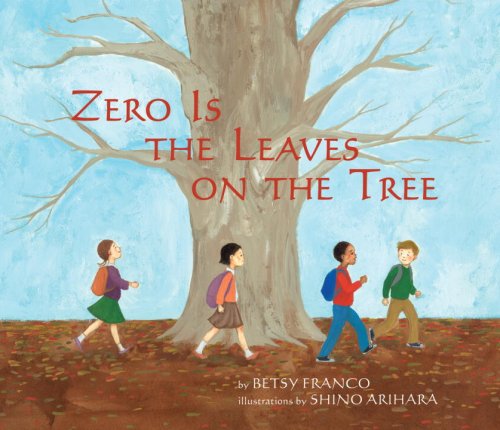
Zero is the Leaves on the TreeI’d seen the book Zero Is the Leaves on the Tree mentioned elsewhere, so when I saw a copy at my library I had to see what the fuss was about. Let me say that there is some well-earned fuss. Taking the reader through the seasons, zero is represented in many ways, including the number of sleds on a slushy hillside or the kites in a windless sky. The beautiful and slight wording on each two-page spread makes the book close kin to poetry.
Zero is...
the leaves on the bare,
brown arms of the oak tree.
I can’t think of another book that gently and beautifully tackles math, seasons, and poetry. Heck, through the lovely illustrations, the book even includes a story of sorts about a diverse groups of four friends going through the school year together. Honestly, it’s such a perfect book that it should not be missed. (Nonfiction Monday is hosted today at Tales from the Rushmore Kid.)

The Winter Blog Blast Tour begins today with some awesome authors appearing at:
Check Chasing Ray for the full week’s schedule.

Links to material on Amazon.com contained within this post may be affiliate links for the Amazon Associates program, for which this site may receive a referral fee.

Nonfiction Monday: Faces of the Moon

Every once in a while an obvious fact hits you in the face and alters your own perception of the world. Like when you (I) realized that the phrase wasn’t “for all intensive purposes” but instead “for all intents and purposes.” Then you (I) look over the past for all the times this fact came into play and was misunderstood by you (me).

Faces of the MoonThat’s how I felt after reading the nonfiction picture book Faces of the Moon, by Bob Crelin. The author takes us through the phases of the moon and how what we see in the sky is affected by the sun’s shining on the moon’s surface combined with the moon’s orbit. The cut-outs on the pages emphasize the moons shape though its cycle, and echo the dynamic cut-out on the book’s cover. All through the book, rhyming couplets describe the phases, with my favorite rivaling the whole Thirty days hath September bit:
Each changing face (or lunar phase)
repeats each nine-and-twenty days;
from thin to thick, from dark to light;
sometimes in day, sometimes at night.
The illustrations of Leslie Evans are created from linoleum block print and watercolor. They are lovely, but what captures me most about the pictures is the story that is told in them alongside the facts about the moon. It seems to be about a boy who is visiting a girl — a cousin? a sister? — in the countryside. He goes home to the city and they talk on the phone looking at the shared vision of the moon out their windows. Then at the end he comes back to the countryside, and they sit on the steps together. I found myself dying to know the story of these two kids, but I suppose that’s my fictional favoritism coming into play.

So what was my great revelation? While I knew about phases of the moon and why they happen and all that jazz, it never occurred to me that the specific phases are connected to particular times of day. For instance, the waning crescent moon rises hours before sunrise and sets in mid-afternoon which is why we always see that particular shape in the morning. Of course I noticed different shapes of the moon, but I never gave it a thought as to what shape appeared at what time of day. Totally eye-opening.

Anyway, this is a lovely, interesting book for kids — or oblivious adults — to find out more about the moon. And maybe to make up a story about the two kids in the picture, so there are some storytelling prospects mixed in as well. For more titles, check out Nonfiction Monday, hosted today at Moms Inspire Learning.

Bearport, Miniature Horses, and Charity Raffle

BearportToday for Nonfiction Monday, I need to mention a publisher that is providing fun, interesting, educational, and high-quality nonfiction titles to children. They are also providing this ah-dorable stuffed bear for our charity raffle at the Kidlitosphere Conference. He’s huge and cuddly, and my kids already don’t want to part with him. But someone at KidlitCon09 will win Bearport along with a few new titles from the Bearport catalog.

One title that I I will not be parting with is Miniature Horses, because, well... look at it! Horses playing soccer in the living room! How cute is that? This title is one of the new series of Peculiar Pets, which features ferrets, iguanas, and potbellied pigs.
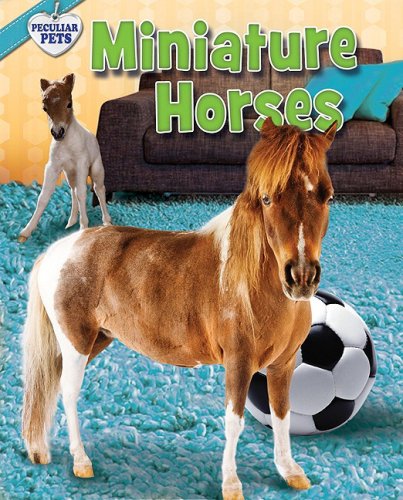
Miniature HorsesMiniature Horses talks about the features and history of the breed, along with their needs as pets. The text is perfect for elementary school readers, and no one will be able to resist the pages of wonderful pictures of tiny horses. Like all Bearport nonfiction, the book features a glossary, bibliography, and fast facts. Now, I love minis so much that I took the whole family to the wildly overpriced — yet insanely cute — Land of Little Horses, so I was completely enchanted with the book. And totally not parting with it even for charity.

KidLitCon 2009 - Washington DCHold it. Perhaps I should back up on the charity thing. At each conference, the host selects a cause and we have a raffle to raise money. The prizes are donated by authors, illustrators, publishers, and bloggers. This year I’ve turned to Donors Choose for our charity, and specifically to impoverished Washington, DC, schools. At this point I’ve selected two proposals to fund. I picked Literacy is Fun-damental because they need Spanish language books, which are hard to pick up at a discount or at a local book sale, and because the picture of the kids is soooo cute. I picked It All Starts With Reading! because they need titles for teens, and the picture of the empty bookcase is soooo sad.

If you aren’t coming to KidlitCon09 and would like to make a donation to these programs, we welcome your contribution. If you are wondering if there is any way to send books directly to these schools, I welcome you to investigate that and get back to me. If you would like to donate items for our raffle, please contact me at MotherReader AT gmail DOT com — especially if you have something besides books. I’m planning on sharing some of my MotherReader original recycled paper jewelry. Yes, it’s just as delightful as it sounds.

Nonfiction Monday is hosted today at Bookends, the Booklist Online blog.

Nonfiction Monday: Round-Up & Pandas

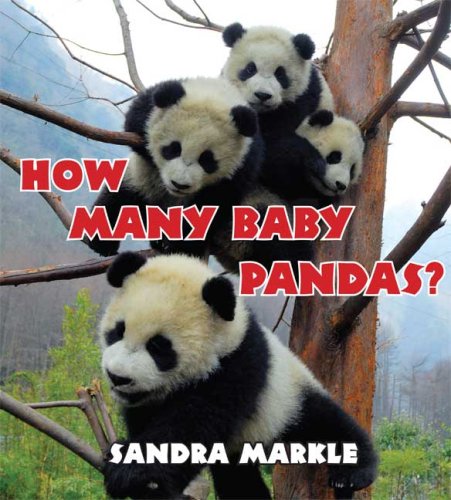
How Many Baby Pandas?Pandas must be the only animal whose adult evolutionary strategy is cuteness. (Well, other than Ashton Kutcher.) They live on bamboo — and only bamboo — which apparently has all the nutritional value of pork rinds. They also weigh two hundred pounds, need a decent-sized range, and sport highly visible markings. No doubt this species would have died out long, long ago if people didn’t protect them because they were just so darn adorable.

How Many Baby Pandas? by Sandra Markle, is a young readers’ introduction to pandas and how people are helping them at Wolong Giant Panda Breeding Center in China. We start with one panda at birth — about six inches long, weighing four ounces, and looking like a pink rat. We follow pandas’ growth in the center and learn facts about the animals along the way. The photographs of pandas wrestling with each other and holding their own baby bottles are as sweet as they sound. Regardless of the title, the counting aspect of the book is certainly secondary. At the end, there are extra facts, glossary, bibliography, websites, and donation information. Good for early elementary school readers or preschoolers who want to learn about animals. Especially cute animals.

Nonfiction Monday Round-up is here today, so leave links in the comments and I’ll update throughout the day.

Edited to Add: Funny story — I told my teen the Ashton Kutcher line yesterday, and she didn’t think it was that funny. I explained it, telling her that it’s only because he’s cute that he has a career, because he hasn’t really done anything. So, today I see an article in The Washington Post about celebrities who are famous for being famous. At the end of the article the primo example is named: Ashton Kutcher.

9:00 a.m. Round-Up
Noon Round-Up

4:00 p.m. Round-Up
  • Life in the Boreal Forest at Bookends. (Doesn’t that sound pleasantly cool during an August heat wave?)

  • A round-up within a round-up with Finding Truth, Then and Now, 14 Cows for America, Truth You Can Trust, and Save This Superstar! all at I.N.K. — Interesting Nonfiction for Kids. (Sorry I missed you earlier.)

7:00 p.m. Round-Up
  • The Frog Scientist at Biblio File, who adds, “MR! You live in DC! Baby pandas don’t look like a pink rat, they’re THE SIZE OF A STICK OF BUTTER!”
HA! (I respond.) I actually had that phrase instead of the pink rat, but I didn’t think anyone would get it! Of course, four years ago everyone in the DC area heard that the new baby panda was the size of a stick of butter so many times that “ButterStick” was one of the suggested names. (They went with Tai Shan.)

Nonfiction Monday: Dazzling Dragonflies

I have the perfect book for Nonfiction Monday and Poetry Month. In fact, I think it ties in pretty well with the upcoming Earth Day, too.

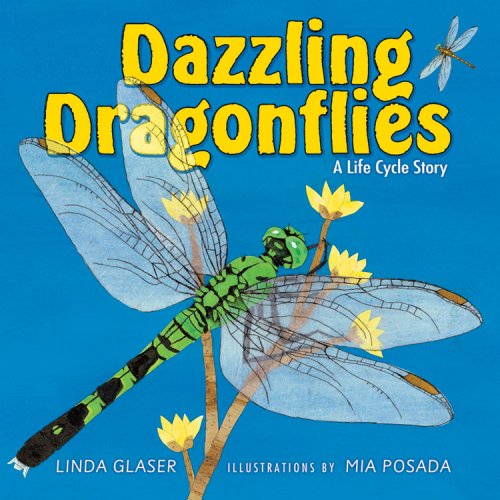
Dazzling DragonfliesDazzling Dragonflies, by Linda Glaser, is not brand-new, but I noticed it recently when the cover caught my eye. The book offers an almost-storybook treatment of the life cycle of a dragonfly, from egg to adult. If not actual poems, the words are poetic and lyrical. Mia Posada provides the beautiful illustrations, where collage-style dragonflies are mixed with watercolor backgrounds and drawings. Overall, a lovely book with lovely words.
Hello, flying dragonfly!
Amazing acrobatic insect —
flitting and floating here
and there.
You dip and dive and dart,
then zip!
For more nature books by Linda Glaser, visit her website. Find more ideas for Nonfiction Monday with today’s host, Abby (the) Librarian. Completely unrelated, but worth noting for this Monday, SLJ’s Battle of the (Kids’) Books is off and running. First to fall: Gaiman. Oh, that hurt!

(I should add my BoB Round 1 guesses. And they are guesses, since in almost every match I’ve read one — and only one — book. So: Octavian, Trouble (a freebie, since I just saw it), Chains, Tender Morsels, Frankie, Hunger Games, Graceling, and Nation.)

Nonfiction Monday: Helen’s Eyes

Helen’s EyesIt would be hard to finish out National Women’s History Month without hearing about Helen Keller or her teacher. I thought that I had read all I needed to on the subject until I found Helen’s Eyes: A Photobiography of Annie Sullivan, Helen Keller’s Teacher, by Marfe Ferguson Delano.

Annie Sullivan overcame incredible obstacles in her own life before becoming the “Miracle Worker.” She grew up poor, with little education. An untreated eye disease left her almost blind by the age of eight, and she went to a poorhouse for years after her mother died when she was ten. Even her horrible circumstances could not squash her intellect, and she was sent to the Perkins School for the Blind at age fourteen. After graduation, she was hired as a teacher for Helen Keller, a young girl who was both blind and deaf.

This compelling biography of Annie Sullivan is made particularly special by the many large photographs throughout the book. When a photo of the subjects themselves isn’t available, another is substituted to give us a visual of the setting — for instance, of children at the Perkins Institute for the Blind. Having grown up with poorly illustrated biographies of both women, I found myself fascinated by the seeing the real pictures.

The author describes the total devotion and link between the two women for the rest of Annie’s life. One picture is particularly telling. In it, Annie’s husband is between Annie and Helen. Annie looks over his shoulder reading the paper in his hands, Helen looks straight ahead in profile, and John is finger-spelling into her hands and looking at the camera. When I saw the photo, my first thought was that he couldn’t be happy — and indeed, John left the marriage right around the time the photograph was taken.

Nonfiction Monday is hosted at Tales from the Rushmore Kid.

Nonfiction Monday: Round-Up

First things first: I’m hosting Nonfiction Monday today, so leave your links in the comments and come back later for a full round-up of nonfiction reviews.

It’s National Women’s History Month, and I have done... hold it, let me see... yes, apparently nothing, nothing at all to bring attention to women in history. I’ve certainly let down the sisterhood. At least I can heap praise on the one site that has books and resources galore, Wild Rose Reader. If March has gotten away from you too, blame the weather and head there for some great reading ideas.

Today I do have a biography about a woman to share. A woman ahead of her time. You might even say a maverick.

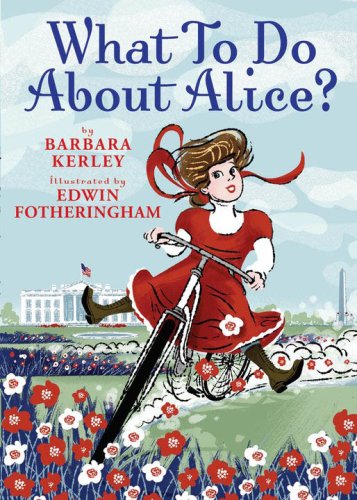
What To Do About Alice?The title and subtitle can serve as a decent one-sentence summary: What to Do About Alice? How Alice Roosevelt Broke the Rules, Charmed the World, and Drove Her Father Teddy Crazy! Of course, the title can’t capture the pleasure of getting into the head of a spirited girl who was all about “eating up the world.” While other girls her age went to boarding school to become proper young ladies, Alice joined an all-boys club and used her father’s library to teach herself astronomy. As she grew up and her father became the President, she refused to settle for a supporting role in her own life. While some women were appalled at her behavior, most of the country loved her outrageous ways.

With What To Do About Alice? Barbara Kerley has written a fun picture book about a fun-loving girl, while also conveying the history surrounding the Roosevelt family. The lively illustrations by Edwin Fotheringham are a perfect complement to the story of Alice — and are the most enjoyable when they are in direct opposition to the text. We can laugh at a picture of Alice and her siblings riding trays down the curving White House steps while the sentence above mentions, “She watched her younger brothers and sister so her stepmother could get some rest.” This was one woman in history who was anything but boring.

Since I’m gathering your nonfiction reviews today, I’ll update this post a few times with those links. C’mon and give me something good to read.

Nonfiction Monday Round-Up, 9:00 AM Edition

We have...

Noon Edition

Plus...

5:00 PM Edition

Adding on...

9:00 PM Edition

Closing out with...

Nonfiction Monday: The Fantastic Undersea Life of Jacques Cousteau

I’m generally not a Dan Yaccarino fan. Nothing wrong with the man or artist, but his work is not my cup of tea. Until now.

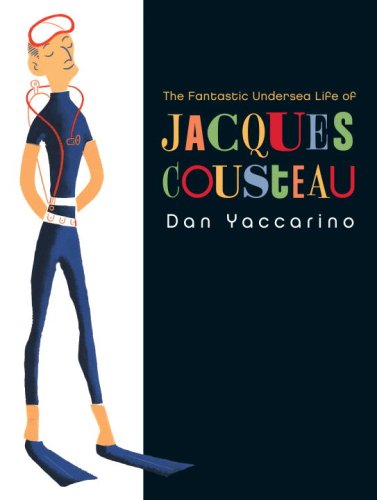
he Fantastic Undersea Life of Jacques CousteauI just received his new book, The Fantastic Undersea Life of Jacques Cousteau from Random House. I was working hard to go into the book with an open mind, but found that I didn’t need to go any further than the title page to fall in love. I was looking at a different Yaccarino than I knew, and I LIKED IT!

The title page is a two-page spread set under the sea with light blues and soft greens in waves, topped by a series of growing soft yellow bubbles emanating from the breathing equipment of a small dark blue figure swimming under the title. Lovely. But the next two-page spread is even better. There the man is in the foreground against the waves of now soft greens and oranges and surrounded by seaweed, fish, and light. Gorgeous!

When the subject, Jacques Cousteau, is out of the water, the illustrations resemble the more typical Yaccarino style of sharp contrasts and edges. When Cousteau is shown in the water, the pictures become magical, with those edges softened, the palette less contrasted, and the whole page filled with an undersea world. Each spread features a quote from Cousteau that accentuates the picture and the text.

It’s hard not to focus on the illustrations in this beautiful book, but the writing works well too. The book is fairly simply written, with only a couple of sentences per page highlighting the main parts of Cousteau’s life. Not knowing much about the man, I found it fascinating. I didn’t realize that as a boy, Jacques was sickly and that doctors encouraged him to swim to build up strength. That advice would come in handy again when he was hurt in a car accident and took to the Mediterranean Sea to swim and build up strength. Then a friend gave him goggles so that he could see underwater. His quote is moving:
Sometimes we are lucky enough to know that our lives have been changed. It happened to me that summer’s day when my eyes opened to the world beneath the surface of the sea.
The book goes on to talk about Cousteau’s advancements in diving gear and underwater filming equipment. It features his adventures in the sea and his commitment to show and protect the world’s oceans. The end of the book lists some of the important events in his life, and gives the resources used for more information.

To sum up all this gushing, I completely recommend The Fantastic Undersea Life of Jacques Cousteau. It’s perfect for school and public libraries, and also for the home libraries of ocean lovers and art aficionados.

Today’s Nonfiction Monday round-up is hosted at L.L. Owens.

Nonfiction Monday: Unite or Die

I’m not sure how I’ve made it through my daughters’ elementary school years without one class play. Sure, I’ve pulled together costumes for Bug Day (second grade), Colonial Day (fourth grade), and Greek Myth Day (sixth grade), but never a class play. Is it just my school or is the country losing this tradition of homemade costumes, adoring parents, and uncomfortable children?

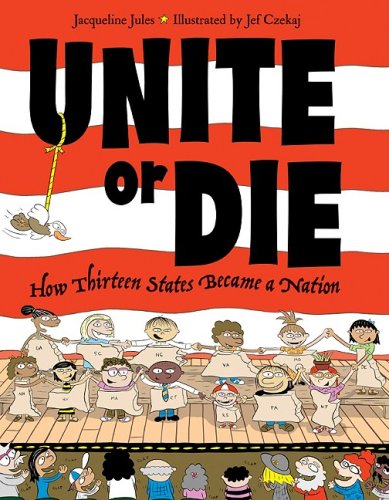
Unite or Die: How Thirteen States Became a NationWell, not in the book Unite or Die: How Thirteen States Became a Nation, where author Jacqueline Jules uses the setting of a class performance to convey historical information. The homemade costumes are on display, as kids wear the thirteen original states around their torsos and ill-fitting wigs over pigtails. The adoring parents are in the front row clapping like Tinkerbell’s life is at stake. As for the uncomfortable children, I’m sure that New Jersey is annoyed that she has to carry a garden plant on her head. (I’m guessing that is a tribute to New Jersey as the Garden State, and also guessing that the artist chose not to tackle the slogan “Virginia Is for Lovers.”)

The kids take us through the time after the Revolutionary War, when America had won its freedom but had yet to become a country. With all the states having separate governments and leaders, they needed to find a way to resolve conflicts between them and make decisions as a nation. Through a narrator’s text and dialogue from the “states” and “statesmen,” the reader learns about the process of forming our government. An afterword and notes section answer additional questions. The cartoons by Jef Czekaj will feel familiar to kids, and keep the illustration fun. I do think that the illustrations could have gone funnier and taken better advantage of the performance aspect — I wanted to see the kid who holds his sign upside down or who knocks over the scenery. Maybe next time.

The book’s style makes a complicated topic more accessible and enjoyable. It’s perfect for classroom use and covers a subject that all American kids will study, even if they don’t have their own class play.

Nonfiction Monday is hosted today at Books Together.